Sunday, March 15, 2020

Slavery and the Crusade of John Armstrong in Kansas


John Armstrong was the closest free-stater living north of Albert Stokes on the northwest quarter of Section 28, also located on Washington Creek. John was born at Oxford, Canada West, on June 8, 1824, the son of Thomas and Sarah Dodge Armstrong. He was an avid abolitionist and always acted with the Abolition party before he came to Kansas. He voted for Martin Van Buren when the latter was the anti-slavery candidate for President. He well remembered the excitement in New York State and New England when the Kansas-Nebraska Bill passed, and he resolved that he would come to Kansas and help make it a free state. 

Leaving western New York on November 1, 1854, he arrived at Kansas City on approximately the 17th or 18th of November. We found at Kansas City on the levee, one Hotel, one barn and six warerooms, and where now the market square is located was a horse mill. We went to Westport where there was quite a village and from there traveled west into Kansas. At Kansas City, John met the notorious Sam Wood, and after ascertaining the latter’s anti-slavery sentiments made arrangements with him to carry his baggage and trunks. There were five in this party which arrived in Lawrence on the night of November 20. 

Armstrong established his claim on Washington Creek and immediately became involved in the Underground Railroad. A proslavery family named Bowen lived on an adjoining claim, which was traversed by a trail from McGee’s Crossing (the main trail crossing the Wakarusa). This family had brought with them from Kentucky a family of slaves, including a father, mother and eight children, the eldest a boy about twenty. 

According to John’s reminiscences, his sister, Sarah, taught these children their letters. They came to the Armstrong house on Sunday for this purpose, unbeknownst to their master. There were other slaves in the neighborhood (a few grown ones), but this was the largest slave family. There were a few slaves who lived up on the head of Washington creek, in the proslavery settlement, where about sixty proslavery men lived. The Negroes told us that Bowen was afraid of our Sharps rifles. He though they would shoot a mile.

Bowen’s colored people built his log house and did general farm work. He brought them there in the spring of 1855, as early as April. He brought his own family at that time too. There might have been 3 or 4 in his family. His son-in-law was a part of the family. The negroes built a little cabin out about ten rods from the house. All of the buildings were of logs. The house was what is called a double-log house, two rooms and an open space between. John states that the proslavery people would get drunk and come and threaten him. He told the Lawrence boys about it, and one night Capt. Randlet and a party of free-state men in Lawrence came out to his place on Washington Creek. 

From there they went over to Bowen’s, cleaned out his whiskey and gave him three days to leave. The Armstrong and Bowen cabins were only a quarter of a mile apart. The eldest colored boy came to John’s house that night with the rest of the children and cried, "Master Armstrong! Some men have come to Master Bowen’s, and I am afraid they are going to kill us." John let them all in – the whole colored family – and asked them who was in the crowd, but the children did not know if the men they were free-state or proslavery men; they just wanted John to run them off. Armstrong had previously talked to them about leaving their master. But a Lawrence Journal World article states that " . . . the slave family wanted Miss Armstrong’s brother (John) to start them on the way to Canada, but the risk was too great and he did not do so." They (the Bowens) took the slaves with them to Westport, Mo. 

John Armstrong credited himself with persuading Jim Lane to come to Kansas. He had met Lane in the spring of 1855 on a boat on the Missouri River the morning after leaving St. Louis. John had been in Kansas since 1854 and had explored with Governor Robinson as far up as the Blue River. He recounted his meeting with Lane at an Old Settlers’ Meeting in 1879
Lane was on his way to Kansas, and when he found out that I had been in the Territory, he wanted to learn all about the country . . . I gave them a general description of the country from the mouth of the Kaw River up to where Manhattan now stands, and of all the country. The location of Lawrence and the Kansas bottom pleased my eyes better than any where else, and I gave them a glowing description of it, and told them that I believed that Lawrence was the place where we should eventually build up a great city. I know I did prevail upon Lane to come to Lawrence, for three days after I got here he came up here with his family. *emphasis author’s"
Later, in an 1896 interview when he was seventy-two, Armstrong further elaborated on his this meeting: If Jim Lane was the greatest man Kansas ever produced – and a good many people think he was – then John Armstrong deserves the credit of discovering the greatest man and starting him in the proper channel. Mr. Armstrong says he came to Kansas to make it a free state, and he didn’t content himself with settling down in the Topeka town site, but he joined Stubbs’ company at Lawrence, received his Sharps’ rifle and marched and practiced with the boys. 

His meeting with Jim Lane is thus recounted by him: 

"I had shipped a large nursery stock to Kansas which I started in 1851 and I expected it to arrive in Kansas City as soon as I returned from up the country, but it only reached St. Louis that fall. I had to go to St. Louis to look after it and in the early spring of 1855 I shipped it to Kansas. The morning I left St. Louis the clerk of the boat came to me and said, ‘Colonel Lane from Indiana and Thomas Shoemaker want to see you and have a talk about Kansas.’ I went down to the ladies’ cabin and was introduced to Colonel Lane and to Mr. Shoemaker, who had been appointed land receiver of the Kickapoo district. I had a pleasant talk with them, and from that time until we arrived in Kansas City we had frequent talks about Kansas. I became satisfied in my own mind that Lane’s object was to organize a Democratic party in Kansas and be its leader. He wanted to settle in the biggest place in the territory and asked me particularly about what I thought would be the best place to go. I gave him the best information I could, and a couple of days after I arrived in Lawrence, Colonel Lane came there with his family. "I introduced him to the boys and we vied with one another in doing what we could for him in running out lines and building a cabin. The willingness of the free-state people to help him, and the willingness of the proslavery party to carry out the Douglas squatter sovereignty bill to the territory, the driving away of true settlers from the polls and the frequent raids of the border ruffians, was what, I think, made such men as James H. Lane and hundreds of others as radical as any of us." 

Lane soon began to come over to the free-state side and became one of the great leaders for the cause; John became one of his lieutenants. I also started an Underground Railroad in 1857 from Topeka to Civil Bend, Iowa. I hired a closed carriage and span of mules. I lived in Topeka then. I took up a subscription to start the thing, and amongst the number that gave me money was Dr. Charles Robinson, who was at Topeka at the time. He gave me ten dollars. I think Sam Wood gave five dollars and Maj. J. B. Abbott five. They were attending the Legislature. I don’t remember all that helped start the first train on the Underground Railroad and I helped establish the depots from Topeka to Civil Bend, Iowa. In Reminiscences of Slave Days in Kansas, John tells how he encountered his first "passenger" on the "Topeka line" of the Underground Railroad.
The first slave I took out of Kansas was a woman. She got away from her masters, and came up to Howard’s, who lived about 2 miles s.e. of Topeka, staied [sic] there about five or six weeks, when some proslavery men from Deer Creek found that she was there and took her back to Lecompton for the reward. One or two of Edward’s boys was with the party that returned her. They lived on the Shunganunga near Frank Dawson’s … Howard had no chance to get the woman onto the Underground Railway. Her name was Ann Clarke. [. . . ] When they got her back to Lecompton it was about evening. They sent out in the country for Clarke to come in and pay the reward. Ann went out in the kitchen to clean herself up. By this time it was pretty dark, and she was studying how to get away. They had given her some cakes to eat, and she put some of these in her budget (a small bag or pouch). The men were in a frolic, had been drinking some. The women only were watching her, but she kept on the watch herself for a chance to escape and finally seizing an opportunity when they were off guard, ran out of the kitchen and up a ravine which was situated near where the foundations of the Territorial Capital State House is in Lecompton. It was a very brushy ravine. She hid in a thick place in the brush, and hid there until most morning. They came out and hunted for her, coming very near her. When it became light enough she followed the ravine up s.e. and came up out onto the top of the hill on the edge of the prairie. Being now daybreak, she could see all about and took her bearings. She finally saw a man coming along the road s.w. of Lecompton and running east towards Lawrence. He had a book under his arm. She thot [sic] a man with a book must be free-state, and went out to talk to him. It was Dr. Barker, the father of Senator Barker of Douglas County. She asked him who lived in the different houses. Finally she found that he was Dr. Barker, a neighbor of G. W. Clarke who owned her (jointly with Col. Titus). He lived east of Lecompton and was credited with the murder of Thomas Barber in 1855. He was a former Indian agent and a prominent border ruffian. He had been out to see a sick woman, and was returning home. She [the slave woman, Ann] asked him to take her to his house and help her get free. He told her to go farther south, to walk down the ravine and come up back of his house. He kept her at his house a day or two, hitched up his team, put in several comforts, covered her over and took her down towards Lawrence, to the house of the father-in-law of George Earle, who brot [sic] her up to me at Topeka, to the residence of Mrs. Scales . . . Mrs. Scales kept her hid for a week before Mr. Scales found it out. Capt. Henry came in on her one morning when she was helping Mrs. Scales wash dishes. He was a strong proslavery man, and was boarding at the house. Mrs. Scales said, "You can keep a secret?" He did and never gave us away . . . We kept her there for about six weeks at our house, while I made arrangements to take her to Iowa.
Much has been written about this house – the residence of Mrs. Scales – at 429 Quincy Street in Topeka. There is some discrepancy as to who actually built it. Armstrong, in his Reminiscences, states that Mrs. Scales, when he built the house placed a sugar hogshead, (a cask capable of containing large amounts of liquid), which he had shipped things from the east in, down in the cellar. When Ann came, we put some straw, clothes, and blankets into the hogshead, and had her stay in it. Mrs. Scales kept boarders, and during the day, while they were out, Ann used to come up in the kitchen and do a great deal of housework. 

 A newspaper article from 1913 also states that "*the stone house at 429 Quincy Street was erected by a Mrs. Scales, who emigrated from New York." But the Topeka Mail & Kansas Breeze article from 1896 states that at the time of that interview, John Armstrong was still living in "the little stone house at 429 Quincy in Topeka, where he had lived ever since coming there in the early 1850’s," and a 1910 newspaper article states that the house was built by John Armstrong himself. 

A 1929 newspaper article corroborates this, stating that ". . . it was constructed in 1856 by John Armstrong, a pioneer in Topeka, when the town had scarcely two dozen houses to break the nakedness of the plains." 

 Whether built by him or not, the house eventually came into John Armstrong’s stewardship – if not ownership – when, after the sudden death of their younger daughter, "the Scales family moved from the house and returned east, leaving Armstrong in possession of the place." 

And there can be no doubt as to its usage in Armstrong’s hands. 

"From this time on the place was the center of a very flood of anti-slavery sentiment. And at this time came the hogshead from New Orleans, and the disappearances of many slaves from the homes of their masters." "I suppose I have kept three hundred slaves in the house at 429 Quincy St., all told," Armstrong is quoted as saying in the 1910 newspaper article, "and every one of them was taken north and eventually reached Canada." 

 Many newspaper articles over the years have recounted the legend of the little stone house in Topeka. From the Topeka Daily Capital of April 21, 1929:
[I]n the basement was placed an immense hogshead, big enough to hold a score of persons comfortably. The hogshead originally had contained sugar, and was shipped up the Mississippi River to St. Louis, up the Missouri to Westport Landing, thence up the Kaw to Topeka. Emptied, it was put in the basement before the joists for the building were laid. At the time Armstrong obtained it, he thought that it would make an admirable hiding place for fleeing slaves . . . Armstrong was the first Topekan to have a station on the Underground Railroad. He received the blacks at night, placed them in the cellar and held them until it was safe for them to continue their journey. Southern soldiers, in pursuit of the escaping Negroes, often halted in Topeka. Pitched battles, in which deaths sometimes occurred, took place in this vicinity. The Old Topeka House, situated where the post office now stands, was thought to be the hiding place of the slaves. This frequently was searched, but the fugitives never were found. No suspicion was attached to the little stone building, just back of the Topeka House. It was so small and innocent appearing, and there seemed no places in it where anyone could be concealed. But had the pursuing soldiers only known it, on many occasions there were a dozen or more slaves concealed in the hogshead at the time they were futilely searching the Topeka House.
From the Topeka Daily Capital of Tuesday, July 5, 1938:
"Old ‘ Undergound Railway’ Cabin in Topeka on Block" Slaves were hidden in the basement, which was entered by a long passage that originally reached to the Shunganunga Creek draw near what is now Fifteenth Street. The entrance to this passage still remains in the basement of the house. The house contains three rooms, one large room on the main floor and two smaller rooms in the basement. Cottonwood was used in the frame of the structure, but it is the walnut siding that gives the house its principal claim to architectural distinction.
The little stone house and the activities that took place there are perhaps best described in an earlier Topeka Daily Capital article, which states:
Slaves were hidden in the cellar . . . there were oftimes as many as a dozen runaway slaves taken care of by Mr. Armstrong and other anti-slavery people . . . The old stone house, which was the refuge of so many runaway slaves, has never been remodeled except for a new roof some years ago and is now the home of a colored family who probably do not know the same roof which shelters them, sheltered people of their own race over fifty years ago who were trying to escape the bonds of slavery.
For the runaway slaves, the stay at the Scales/Armstrong house at 429 Quincy St. in Topeka was only the beginning of what could turn into a harrowing Slaves were hidden in the cellar . . . there were oftimes as many as a dozen runaway slaves taken care of by Mr. Armstrong and other anti-slavery people . . . The old stone house, which was the refuge of so many runaway slaves, has never journey to freedom. In the 1910 Topeka Daily Capital article, Armstrong related that
. . . [w]e used to ford the Kaw River about where the bridge now stands always traveling by night and lying under cover during the day. Holton was the first station north and from there we went to Nebraska City and crossed the Missouri River at that point. After reaching Silver Bend, Iowa, we turned the slaves over to the Quakers and from that point it was an easy matter to place them on Canadian soil . . . I sometimes rode a pony on my trips, but unless I had some women in the party I usually walked and slept on the ground. I took up one other woman. I don’t remember how she came to me. A Mr. Mills, a Topeka man, went with me all the way thru and returned with me . . . The road was about this way: We went first to Rochester, to Bowker’s in the night. The next stopping place would be Holton, at Smith’s or at Reynold’s, who lived a mile west of Holton, on the Creek. Another place was five miles north of Holton, where Brown was caught at the Battle of the Spurs. In crossing that creek, I got stuck, and had to get the woman out of the buggy. This was on the Jim Lane road. On my way up that first time I followed the track of Kagi [John Brown’s right-hand man who later died in the raid on Harper’s Ferry], who had started out three weeks before me to visit his father . . . We afterwards sent several women up. Some came from Missouri, some from Kansas.
Armstrong and Mills took the slaves from Topeka north over the Lane Trail. They were covered in a wagon, which was closed. The wagon had a false bottom to be used in cases of emergency; over this false bottom were spread hay and straw. The first stopping place north of Topeka was the farm of William Bowker. William Owens lived next door to Bowker, and sometimes his house also was used as a station on the Underground Railroad. 

 On his first trip with the slave Ann Clarke, Armstrong recounts, 

"We started in the very last days of February 1857, and I was gone three weeks. We went to Civil Bend, Iowa, to Dr. Blanchard. From there we sent her on the Chicago. The trip was without incident as far as Nebraska City. Approaching there, Armstrong concealed the Negroes beneath the false bottom in the wagon bed. Border ruffians halted him and looked in his wagon for slaves, but did not find them. 
That night Armstrong drove to Civil Bend, several miles up the Missouri. Kagi had been sent ahead of this first consignment over the underground, and was waiting for Armstrong at Nebraska City. He conducted the cargo of slaves to the ferry at Civil Bend, where he aided Armstrong to cross the Missouri River. The crossing was a dangerous matter, as ice was running in large pieces. The ferryman had to be persuaded with a Colt’s navy (revolver) before he would undertake the passage. The boat was carried down the river half a mile by the ice but finally made the east shore safely. 

The slaves were delivered to Dr. Ira D. Blanchard, who lived near Civil Bend on the Lane Trail, and a few miles from Tabor, Iowa. Kagi’s father lived at the time in Nebraska City and he also aided Armstrong to escape from the town with the slaves. The Underground Railroad over the Lane Trail was in operation as long as it was necessary for slaves to leave Kansas for Canada. John Brown himself left Kansas forever over the Lane Trail in late January 1859. On his last exit from Kansas, while delivering slaves, he ran into trouble north of Holton, Kansas. 
He sent a farmer named Wasson, whose anti-slavery sentiments were well-known, back to Topeka to tell Colonel John Richie that John Brown was surrounded in a cabin (Fuller’s) on Straight Creek.
It was Sunday morning when Wasson reached Topeka, and Richie and his family were part of a congregation gathered at a schoolhouse which stood at Fifth and Harrison and served as the meeting place for Congregationalists. A commotion was heard at the rear of the building causing people to turn toward the door. John Armstrong walked immediately to Richie’s seat and whispered in his ear. They both left the church and after hastily collecting a few men, hurried to the aid of the "Old Puritan". They helped disperse the enemy at the crossing on Straight Creek near the Fuller cabin, in the Battle of the Spurs. 

This battle, which occurred on January 31, 1859, received its name from Richard J. Hinton, an eastern correspondent who had come to Kansas. "As spurs were the most effective weapon used, the title is not altogether inappropriate. Not a shot was fired on either side. A different explanation for the battle’s odd name was written by G. M. Seaman: Some (of the men) had gotten their horses and some were afoot, but as they got out of the woods those that were afoot grabbed hold of the tails of the horses of those who were mounted and away they went sailing over the prairie, hence it was dubbed the "Battle of the Spurs." John Armstrong went on to live a long life. As stated above, he was still living in the stone house in 1896. The 1910 Topeka Capital article states that Armstrong, then 86, was living at Keith’s Hospital. He died less than a year later, on Dec. 19, 1911. His obituary appeared in the Topeka State Journal for December 20, 1911:

Anti Slavery Fighter Dies

John Armstrong, 87 years old, and the last survivor of the handful of pioneers which selected the location for a city where a town site company a fortnight later founded Topeka in December 1854, died last evening at St. Patrick’s Hospital and will be buried in Rochester Cemetery, where he already has had his monument erected and inscribed with the exception of the date of his death* . . . He was active in making Kansas a free state and established an underground railroad north from Topeka. 

He was with both Lane and Brown in their border warfare. He never married, remaining true to Eunice Scales, a young woman he met shortly after coming to Topeka, but who died of smallpox before their wedding could be arranged. The above sad account may hold a key to the fervor with which John Armstrong approached his Underground Railroad activities. 

 The peculiar recklessness and energy for excitement that possessed John Armstrong might be hinged on a pathetic romance that filled his life during the first two years in Kansas. Mrs. Scales brought with her two daughters when she came to Kansas and old-timers who know the facts state beyond a doubt that the Scales home was a popular place in the eyes of the young men of Topeka. 

But above all suitors for the younger of the two daughters stood John Armstrong. He had followed the family from New York to Kansas and in this Far Western State stopped with them and continued the avowal of his loyalty. All went well with the pioneer lovers and the affair was settled in the minds of Topekans. Then Miss Scales died with a contagious disease after a sickness of but a few days. After the funeral John Armstrong walked the streets for many days, seemingly without energy. 

Was it John Armstrong’s abolitionist fervor that brought him to Kansas, or did he follow his heart here and turn to anti-slavery zeal only after his heart was broken? One thing is for certain; it has been 145 years since John Armstrong set foot on Kansas soil, but his footprints left an indelible imprint on the struggle to make Kansas free.  

Friday, February 14, 2020

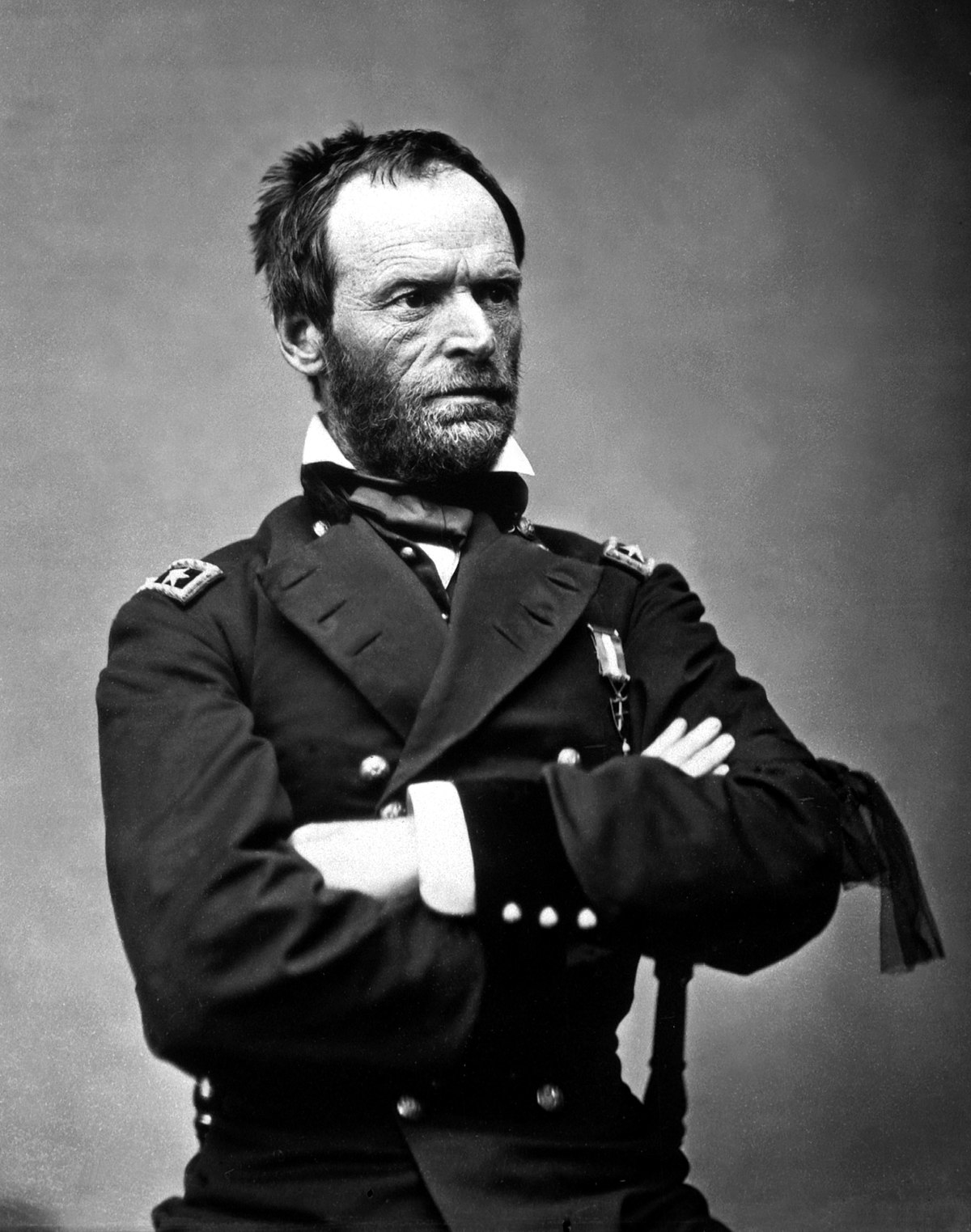
St. Louis and Civil War General William Tecumseh Sherman

General William Tecumseh Sherman is one of the best known Union generals of the Civil War. His famous "March to the Sea" was the death knell for the Confederate States. His services prior to the war were as the superintendent of the Alexandria Military Academy in Louisiana. With the pending secession of Louisiana, Sherman submitted his request to be relieved of command of the academy on the grounds that if "Louisiana withdraw from the Federal Union, I prefer to maintain my allegiance to the Constitution as long as a fragment of it survives; and my longer stay here would be wrong in every sense of the word." He then moved his family to Lancaster Ohio and had an occasion to the meet President Abraham Lincoln with his politician brother John Sherman. He came away adamant on staying out of the hostilities that were coming, instead preferring to dedicate himself strictly to his family. He relates in his memoirs that,
I was sadly disappointed, and remember that I broke out on John, damning the politicians generally, saying, "You have got things in a hell of a fig, and you may get them out as you best can," adding that the country was sleeping on a volcano that might burst forth at any minute, but that I was going to St. Louis to take care of my family, and would have no more to do with it. John begged me to be more patient, but I said I would not; that I had no time to wait, that I was off for St. Louis; and off I went.
Sherman resided in St. Louis on Locust Street between Tenth and Eleventh streets at the time South Carolina seceded in 1861 and was employed by the St Louis Railroad Company. After the bombardment of Ft Sumter, he was offered the position of chief clerkship of the War Department, which he declined, stating that,
Hon. M. Blair, Washington, D. C. I received, about nine o'clock Saturday night, your telegraph dispatch, which I have this moment answered, "I cannot accept." I have quite a large family, and when I resigned my place in Louisiana, on account of secession, I had no time to lose; and, therefore, after my hasty visit to Washington, where I saw no chance of employment, I came to St. Louis, have accepted a place in this company, have rented a house, and incurred other obligations, so that I am not at liberty to change. I thank you for the compliment contained in your offer, and assure you that I wish the Administration all success in its almost impossible task of governing this distracted and anarchical people. Yours truly, W.T. SHERMAN
The letter, Sherman tells, was told that it gave offense and that the President's cabinet felt Sherman would "prove false to the country." Even his friends were a bit skeptical of Sherman’s political position, so Sherman addressed a letter to the War Department, showing his allegiance to the Union, but only to a certain extent:
Office of the St. Louis Railroad Company, May 8,1861. Hon. S. Cameron, Secretary of War, Washington, D. C. Dear Sir: I hold myself now, as always, prepared to serve my country in the capacity for which I was trained. I did not and will not volunteer for three months, because I cannot throw my family on the cold charity of the world. But for the three-years call, made by the President, an officer can prepare his command and do good service. I will not volunteer as a soldier, because rightfully or wrongfully I feel unwilling to take a mere private's place, and, having for many years lived in California and Louisiana, the men are not well enough acquainted with me to elect me to my appropriate place. Should my services be needed, the records of the War Department will enable you to designate the station in which I can render most service. Yours truly, W. T. SHERMAN.
However, he was present and witnessed the events at Camp Jackson and the discontent the people held for the Union, hurrahing Jeff Davis, and eventually shots being fired. He realized that he could no longer hold back his desire to avoid getting involved. He received a dispatch from Washington telling him he had been appointed Colonel of the Thirteenth Regular Infantry. He had originally believed he would come back to St. Louis to raise his own regiment at Jefferson Barracks, however, he notes in his memoirs that "the Government was trying to rise to a level with the occasion. Mr. Lincoln had, without the sanction of law, authorized the raising of ten new regiments of regulars, each infantry regiment to be composed of three battalions of eight companies each; and had called for seventy-five thousand State volunteers." His stay in St. Louis of two months ended. He stated that
…satisfied that I would not be permitted to return to St. Louis, I instructed Mrs. Sherman to pack up, return to Lancaster, and trust to the fate of war. I also resigned my place as president of the Fifth Street Railroad, to take effect at the end of May, so that in fact I received pay from that road for only two months' service, and then began my new army career.
When the war ended Sherman remained in the military, rising to General in Chief of the Army from 1869 to 1883. During that time, he moved his headquarters back to St. Louis. When he retired from the Army he moved to New York City and died on February 14, 1891 at the age of 71. At his request, Sherman was transported back to St Louis and buried in Calvary Cemetery.

Monday, February 10, 2020

Of those who suffered the most during the Civil War, the family is clearly at the top of the list. Not only were there sectional divides between North and South, but citizens of towns against each other, friendships lost over the divide, and families torn apart. The Civil War has often been described as pitting brothers against brothers. In fact at the Battle of Wilson's Creek on August 10, 1861, both Joseph Shelby, member of the Missouri State Guard, and his stepbrother Cary Gratz, soldier in the 1st Missouri Infantry, U.S., fought on Bloody Hill.

The War, however, was not limited to the battlefield as political differences created painful divisions among family members. The State Historical Society of Missouri Research Center-Rolla, contains a valuable anthology entitled, The Hunter-Hagler collection, which reveals how women endured through the Civil War and the struggles one matriarch, Elizabeth Hunter, faced in trying to keep her family together through the perils of wartime. The Hunter family lived in Jasper County, Missouri. The collection provides letters written by Elizabeth Hunter and her daughters, Priscilla A. Hunter and Charlotte Elizabeth (Hunter) Hagler. The correspondents contained in this collection are to Elizabeth's daughter Margaret Hunter-Newberry, who married and left the family farm. The letters are very candid and expose graphic details about daily life in Southwest Missouri.
We hear of horse steeling every week or too Motly's horses was stoled a few nights ago all they had at home they went to the Sarcoxie mill last week and told the miller if the ground another grain he would kill him so the mill is standing the water is so low wee can hardly git grinding done atal we hear the drouth is awful in the north part of the state and the rebbels killing burning and destroying worse than they are here Jenison [Charles Jennison] is let loose among them I hope he will give them justice the rebels are under no law and the malitia is bound down not to pester anything that belongs to a sworn secish they can ride fine horses but if we go we have to walk we can't keep a horse here the union party is on the decline we cant keep nothing for the bushwhacks but the secish is let alone Mag I cant be a secesh there is no use trying I am furder from it all the time to see how they are killing our men distroying our cuntry who can claim themfor there party. They have killed Mr Clark Peter Baker Mr Seymore Brice Henry John Blake Pearson Lorence and Alfred Lawrence around here this summer. - Elizabeth Hunter and to Margaret (Mag) Hunter Newberry-Aug. 11, 1864
Guerrilla warfare spread throughout the Midwest region like a brush fire, hitting hard especially the southwest corner of Missouri along the Kansas border. Marauding bands of men would terrorize civilians, ransacking their homes, pillaging whatever goods they had available, and then burning their homes so nothing remained. Those who were witness to these atrocities were women and children. With the landscape of southwest Missouri devoid of men, women were called upon to offer up their reproductive duties, i.e. their children and their domestic powers to support the men fighting.

The Civil War offered women a rare opportunity to step into traditionally masculine roles, without the fear of ridicule or of being ostracized. Many women arose to the challenge and adapted into the roles previously held by their husbands, fathers, and brothers. Women were now working as the head of all aspects of their household, business, or farm. Facing violence, managing a home without a secure network of support, raising a family in the midst of disease and deprivation, tending to crops with a diminished workforce...all combined though to make hardship an everyday reality for these intrepid women.

That reality though proved to be too much for Elizabeth Hunter and her family to handle so they relocated to Illinois in 1864 and remained there until the war was over. The Hunter family was just one of the hundreds of families that were forced to abandon their homes and move to a safer location due to the hostile environment created by the war. Increase in guerrilla warfare along the Missouri-Kansas border forced General Thomas Ewing to issued Order No. 11 on August 25, 1863, in an effort to depopulate the area of guerrilla supporters. The order mandated all citizens living in Bates, Cass, Jackson, and the northern half of Vernon County to evacuate their homes immediately and seek refuge in another area.

To make matters more complicated for Elizabeth, she also had to deal with an on-going conflict with her daughter Margaret. Margaret was allegedly a secessionist and through the context of the letters it is clear that Margaret felt very disconnected from her family because of their opposing beliefs. Elizabeth adamantly professed her love for her daughter and all her children, but she refused to change her stance on supporting the Union, and tried to persuade her daughter to reconsider her secessionist position.
I am always glad to hear from you, dont let such thauts enter your mind that I ever get tired of yet I would like to be with you all the time. I love you with that love that none but a mother knows it distresses me to think that my child has any fears that I have forsaken [MS torn]ntend long as I have a heart to love any thing I will love my children and be there true friend as I have always been, dont think because we differ in opinion in war matters that I aint your friend I can tell you that I think the rebbels and copperheads are all wrong they will see it when I fear it will be too late. -Elizabeth Hunter letter Jan. 10, 1865
Whether Elizabeth and her daughter Margaret ever reconciled after the war ended is unknown. However, one may speculate that Margaret did find some peace with her mother, since she kept all the letters she wrote to her. The Hunter-Hagler letters are a powerful collection depicting the hardships many families faced in a politically torn region as neighbors and even families turned on one another. The Hunter-Hagler collection is housed at the State Historical Society of Missouri Research Center-Rolla. The collection was digitized for inclusion in the Community & Conflict project, which serves to explore the war's impact on the Ozarks. Digital scans and transcripts of the Hunter-Flagler letters can be viewed at: http://www.ozarkscivilwar.org/archives/1044. Original article by Rachel Regan

Tuesday, January 7, 2020

The Other Sigel


During the mid-nineteenth century the world was in an uproar. Many countries in Europe were struggling with revolutions. In Prussia, the idea of combining the German states into a unified, single Germany, was part of the revolutionist’s plans. But because of the failed reforms, many of these revolutionaries - most of who were highly educated, politically astute and militarily trained – fled to the United States in a search for a new life. Called “Fourty-Eighters” because of their involvements in the revolutions of 1848, many of these Europeans arrived in America and became not only prominent citizens, but also contributed to and invested in their new homeland.

German immigrants also enlisted, some voluntarily and other not so voluntarily, in the United States Army. With the threat of secession of the southern states and what looked like a civil war brewing, many of these Germans sided with their new found country in the effort to maintain the Union, and some, to fight against the southern support of slavery. With a rise in German immigrants, there were German officers appointed to spur these immigrants towards enlistment. This is a brief look at one such German that, by circumstances or fate, fell into obscurity behind his famous General brother and has been lost to the passage of time.
Colonel Albert Sigel was born in Sinsheim, Rhein-Neckar-Kreis, Baden-Württemberg, Germany on November 13, 1827. He was the third child Franz Moritz Sigel (1788 – 1864) and Anna Marie Pauline Lichtenauer, both of Germany, along with his brother, the famed Civil War General Franz Peter Sigel (1824 – 1902), and his other siblings Laura, Theresa, Emil and Karl Sigel. Colonel Sigel immigrated to the United States in 1851 along with many other Europeans, including his brother Franz, who were called “Forty-Eighters” in reference to their participations in the failed European revolutions of 1848. He was naturalized in New York, NY on October 24, 1860.

Colonel Sigel married Rosa Fischer (1844 – 1939) of St Louis, Missouri on March 26, 1863 in St. Louis, Missouri. The Sigel’s had six children, Amalia (1864 – 1953), Moritz (1866 – 1933), Anna (1867 – 1951), Lena (1870 - 1967), Emma (1872 - 1966), and Albert (1878 – 1880).[1] Of the six Sigel children, only Amalia ever married (to Robert G. Bremerman) and they had no sons. The other Sigel children had no children of their own and lived with their mother until her death. Earel Albert Sigel died of meningitis at the age of 1 year, 10months and 6 days, thus ending any direct male lineage from Albert Sigel. Col. Sigel's wife Rosa, along with Amailia, Moritz, Anna, and Lena were all cremated at the Missouri Crematorium in St. Louis.[2]
Sigel enlisted in the U.S. Army on May 28, 1861 in New Jersey and commissioned a captain of Company D, New Jersey 2nd Infantry Regiment. He mustered out of this regiment on December 14, 1861. Sigel was given the rank of Colonel on May 19, 1862 and commanded the Booneville State Militia Cavalry Battalion (“Epsteins”) which was organized at Booneville, MO. March 24, 1862. This militia unit saw a few skirmishes in central Missouri until it was re-organized as the 13th Regiment Missouri State Militia Cavalry.
On October 18, 1861, while commanding the 13th MSM Cavalry, Col. Sigel was involved in an investigation of the killing of rebel prisoners in Waynesville.
The 13th MSM Cavalry was involved in an engagement in California House, MO (now just California, MO) in which Col. Sigel gave the following report;

OCTOBER 18, 1862. - Skirmish at California House, Mo.
Report of Colonel Albert Sigel, Thirteenth Missouri Cavalry (Militia).
HDQRS. 13TH Regiment CAV., MO. S. M.,
Waynesville, Mo., Oct. 18, 1862.
COLONEL: In compliance with your dispatch, received last evening that 200 rebels had crossed the Missouri at Portland the night before and tried to make their way south, I thought it best to let them come near our post, so as to be able to intercept them whenever they tried to cross our line. I therefore ordered Captain Murphy, after midnight, with portions of four companies, numbering 75 men, toward the Gasconade, while I had another force of about 100 men ready to throw on them whenever I could get information where they intended to cross.
At about 10 o'clock this morning I received a report that Captain Murphy had not only found their trace, but was in hot pursuit of them. It was also reported that they had turned southwest, and it was now certain to me that they would cross our line 7 miles west from here, near the California House. I immediately started there with the force already mentioned, and we were scarcely ten minutes near the California House when they drove in our advance guard, under Lieutenant Muller, of Company A, who fell back and brought them into the line of Lieutenant Brown, of Company F, whose men were dismounted. We now pitched into them from all sides, and in a few minutes they ran for their lives. Captain Murphy was also nearly up at that time, and drove a portion of them before hi, scattering them in all directions.
The estimate of the rebels killed is 20, among them Lieutenant Tipton, and as many are wounded. We captured a secesh [sic] flag, 2 roll-books, some horses, and some shot-guns and Austrian rifles; made 3 prisoners, and liberated 2 Union men, who they had prisoners. We had only 1 man slightly wounded. I ordered the secesh [sic] population of the neighborhood to bury the dead and to care for the wounded rebels.
The rebels were well armed and equipped and 250 to 300 strong. They were commanded by Captain Ely, Captain Brooks, and two captains both with the name of Creggs, and were a part of Colonel Porter's command, who did not cross the Missouri with them, but promised to follow them with a large force.
All our officers and men behaved well. Captain Smith (Company H) has not yet, at 8.30 p. m., come back from pursuit the rebels.
I remain, colonel, very respectfully, your obedient servant,
ALBERT SIGEL,
Colonel, Commanding Thirteenth Regiment Cavalry, Mo. S. M. [3]
He again assumed command as Colonel of the 5th Regiment Missouri State Militia Cavalry when it was reorganized from the 13th Missouri State Militia Cavalry on February 8, 1863.[4] The 5th MSM Cavalry was attached to the District of Rolla, Department of Missouri up until June 1863 where it was then assigned to the District of the Border, Department of Missouri up until October 1863 then reassigned back to the District of Rolla until the regiment mustered out on July 8, 1865.

The 5th MSM Cavalry saw most of its action in and around the area of Waynesville, MO. where the headquarters was located atop a bluff overlooking the town as well as the Wire Road, a main supply route from St. Louis to Springfield, MO. Most of this action involved skirmishes and scouting missions against Missouri bushwhackers who were southern sympathizing, irregular forces. 

On March 25, 1864, Brigadier General Odon Guitar, commander of the District of Rolla and Col. Sigel’s commanding officer, was relieved of command and Col. Sigel, in accordance with General Order #25, was directed to assume command of the District of Rolla, in which Col. Sigel responded that he would indeed fulfill this role. In November 1864 he continued this role as commander of the Rolla District and after the evacuation of Fort Davidson in Pilot Knob, MO, awaited the arrival of Brigadier General Thomas Ewing.[5] In a report given by Brigadier General John McNeil, Col. Sigel received praise for setting up a secure defense in anticipation for the continuing threat of Confederate General John S. Marmaduke and General J.O. Shelby General McNeil stated that, “By the 3rd of October, so assiduously and faithfully had the working parties performed the tasks allotted, for which too much praise cannot be given to Colonel Albert Sigel, Fifth Missouri State Militia Infantry, commanding the post.”[6]
After the Civil War, Col. Sigel served as Adjutant-General of Missouri and as a notary public.
Colonel Sigel died on March 16, 1884 at the age of 56. The St. Louis Republican newspaper printed the following obituary of his passing:

BURIAL OF COL. ALBERT SIGEL.
From the St. Louis Republican, March 18.
Col. Albert Sigel, Adjutant-General of Missouri under Gov. Brown, was buried yesterday. There were few persons in attendance and no services at the house or grave. Col. Sigel was the brother of Gen. Franz Sigel, and was a native of the Grand Duchy of Baden, having been born at Sinshein, Baden, Nov. 13, 1827. He had a military education and saw some service before coming to this country. Col. Sigel during the war was in command of the Fifth Regiment Cavalry, Missouri State Militia (formerly the Thirteenth.) He was appointed Colonel of the regiment May, 19, 1862, and was mustered out with the regiment at the expiration of its term, Jan. 7, 1865. The regiment aggregated 1,100 men, was well mounted, and the condition of the horses was as good as that of the horses of any mounted regiment in the Missouri Department.[7]
At the time of his death, Col. Sigel lived at 1853 or 1929 Linn Avenue in South St. Louis, which today would be located at the I-44/I-55 interchange, southeast of Lafayette Park. Many of the streets no longer exist (including this section of Linn Ave.) and quite a few others now have different names.

The St. Louis Death Registry shows that Col. Sigel is buried at “New Picker’s Cemetery” which was seized by the City of St. Louis and renamed Gatewood Gardens Cemetery. Unfortunately, the records from 1861 to 1891 are missing and all that is left is a handwritten transcription of the log, with Col. Sigel not found. So he is most likely buried in an unmarked grave at the cemetery, lost to time.

Colonel Sigel has been mostly lost to time in the shadow of his brother Franz, by children that left him no heirs, and the march of time. However, history shows him as a dedicated soldier and commander for the United States, a public servant to the state of Missouri


Works Cited
National Park Service. The Civil War Soldiers and Sailor's Database: Battle Units. n.d. http://www.nps.gov/civilwar/search-battle-units-detail.htm?battleUnitCode=UMO0005RCY2 (accessed January 6, 2015).
New York Times. "Burial of Col. Albert Sigel." New York Times Obituary, March 21, 1884.
The Union Army: A History of Military Affairs in the Loyal States 1861-65 Records of the Regiments in the Union Army-Cyclopedia of Battles-Memoirs of Commanders and Soldiers. Vols. V Cyclopedia of Battles A - Helena. Madison, WI: Federal Publishing Company, 1908.
United States War Department. The War of the Rebellion: A Compilation of the Official Records of the Union and Confederate Armies. Washington D.C.: Government Printing Office, 1901.
Wood, William D. Report of the Adjutant General. St. Louis: Headquarters State of Missouri Adjutant Generals Office, 1863.


[1] Year: 1880; Census Place: St. Louis, St. Louis (Independent City), Missouri; Roll: 721; Family History Film: 1254721; Page: 637C; Enumeration District: 100
[2] Missouri Secretary of State, “Missouri Digital Heritage” Missouri Death Certificates, 1910-1963. http://www.sos.mo.gov/records/archives/archivesdb/deathcertificates/Default.aspx
[3] United States War Department. The War of the Rebellion: A Compilation of the Official Records of the Union and Confederate Armies. Washington D.C.: Government Printing Office, 1901. Serial 019, Page 0321, Chapter XXV.
[4] Wood, William D. Report of the Adjutant General. St. Louis: Headquarters State of Missouri Adjutant Generals Office, 1863, p. 483.
[5] Ibid., Serial 086, Page 0707, Chapter LIII.
[6] Ibid., Serial 083, Page 0375, Chapter LIII.
[7] New York Times. "Burial of Col. Albert Sigel." New York Times Obituary, March 21, 1884.

Monday, January 6, 2020

Guerrilla warfare and the Civil War in Missouri

Missouri "partisan" soldiers at Fort Davidson
in Pilot Knob 2007
Lets take a look at a topic that has been discussed in Missouri for over 150 years - the Civil War in Missouri, and in particular, guerrilla warfare.
The American Civil War is a period that evokes many perceptions. To most people, the first things that usually come to mind are slavery, Gettysburg, Robert E. Lee, Ulysses S. Grant, and the assassination of Abraham Lincoln. Most people think the war took place solely east of the Mississippi River and was fought mostly in the eastern portion of the United States.
The state of Missouri, however, saw more battles within its borders than any other US state and was only eclipsed by Virginia and Tennessee in total number of battles fought. And while there were major battles that took place in the state involving regular army units from both the Union and Confederate ranks, a large portion of the conflicts that took place were between the everyday citizens of the state.
These men were usually from rural areas and one could argue that they fought not for slavery (the vast majority of these men did not even own slaves) but over areas of land that had little to no governmental control. Some of these men, however, fought for more insidious reasons which included the murdering of innocent people.
These men, called bushwhackers (the term refers to their guerrilla-like tactics of hiding out in "bushy" areas and then ambushing their victims), were, in general, usually part of the irregular military units of both the Union and the Confederacy and since they were not part of the regular army, both governments struggled with how to deal with these bands of men; should they be treated as legitimate military operations or criminal actions.
Many of the bushwhackers in Missouri used a form of guerrilla warfare known as “People’s war” as their primary means of warfare as opposed to standard, military style operations. This usually included neighbor against neighbor fighting to settle grudges and disputes but on rare occasions would consist of these civilians banding together to fight against opposing troops.
The other type of guerrilla warfare used by the bushwhackers was "Partisan warfare". This type of guerrilla warfare differed in that it was comprised of small forces that were in turn controlled and/or organized by a larger military organization. This ultimately led to these groups of "partisan rangers" being perceived as having more "legitimacy" than their bushwhacker brethren.
Here are the stories of a few of these famous (or as some may say infamous) bushwhackers and partisan rangers of Missouri.
William Clarke QuantrillThe "kingpin" of all the guerrilla leaders in Missouri was undoubtedly William Clarke Quantrill. Quantrill led many raids and attacks on known Union towns and against Union soldiers as well as robbing stagecoaches. These actions led Union commanders to brand him an outlaw, even as he apparently secured a captains rank in the Confederate army in charge of partisan rangers.

Quantrill is probably best known for his raid and sacking of Lawrence, Kansas in 1863. Lawrence had strong ties to the Union and was the base for the abolitionists in Kansas. When a makeshift jail collapsed, killing four young women accused of supporting Quantrill's Raiders, Quantrill and his men blamed the collapse on the Union. With the fire fueled Quantrill ordered the attack on Lawrence, and by his orders, his guerrillas killed 183 men and boys "old enough to carry a rifle".

Quantrill met his end in Kentucky when he rode into a Union ambush on May 10, 1865. He was shot in the chest and died on June 6th.

William T. "Bloody Bill" AndersonOne of Quantrill's allies was another notorious guerrilla of note, William T. "Bloody Bill" Anderson. Two of William T. Anderson's sisters, Josephine and Mary were in the collapsed jail in Kansas City that fueled the fire for the attack on Lawrence. Josephine was killed and Mary was crippled. Anderson rode with Quantrill's Raiders until a dispute with Quantrill in Texas led Anderson to head his own band of partisans and they headed back to Missouri.

Anderson was known for his savagery and made a habit of not only shooting his prisoners, but also mutilating and scalping them. This was the case on September 27, 1864 during the Centralia Massacre where he killed, mutilated and decapitated almost 150 Union solders.

Anderson met his end when he led a charge against an ambush in Ray County, Missouri. Anderson fell from the saddle after having been shot twice in the head. His remains were taken to Richmond, Missouri where he was put on display, then decapitated, his head stuck on a pole and his body dragged through the streets before being buried in an unmarked grave.

Bill WilsonThe name Bill Wilson is probably one you have never heard of in reference to the Civil War, but his story is probably one of the most interesting and one that could be said is the story of Missourians in the Civil War. Bill Wilson lived in the foothills of the Ozarks in the Phelps county Missouri area. He maintained a neutral stance leading up to and during some of the war. This changed when his wife and children were pulled from their home by Union soldiers and then watched it burn to the ground. Wilson went on a killing spree and enacted his vengeance on anything and anyone even remotely having ties to the Union or with the attack on his family.

Wilson was notorious for being unrivaled when it came to shooting and was also very adept at ambush techniques. The foothills of the Ozarks, and the close family ties there afforded Wilson considerable security. As the war continued Wilson enacted his vengeance and was considered a criminal for his actions by Union commanders and ultimately fled to Texas.

At this point the story of Bill Wilson becomes cloudy, as no one is completely sure what happened to him. Some stories have him joining William Quantrill while he was in Texas. According to the book "Bushwhacker" by George Clinton Arthur, Wilson was shot to death in March 1869 by two Missourians, John Thompson and William O. Blackmore and supposedly covered with brush in a hasty burial.

Both men were tried and hung in Sherman, Texas. No grave or remains have been found to date of Bushwhacker Bill Wilson.

One would be remiss to leave out Jesse James, his brother Frank James and Cole Younger as three of the most recognizable and notorious bushwhackers or partisans in Missouri's history. We will discuss them in a future article. Their eventual notoriety would be a direct result of their respect, admiration and tutelage of their mentors, William Quantrill and Bloody Bill Anderson.